Blog 8 min read
Banking test data: cloud, on-premise and sovereignty
- security
- test-automation
- quality-assurance
- devops
- mobile-testing
Automating a payment, an account opening or a banking authentication journey is not just about driving an interface. The robot may handle credentials, phone numbers, test accounts, screenshots, videos, logs, tokens or transaction references.
An architecture question therefore arises: where is this data processed and stored?
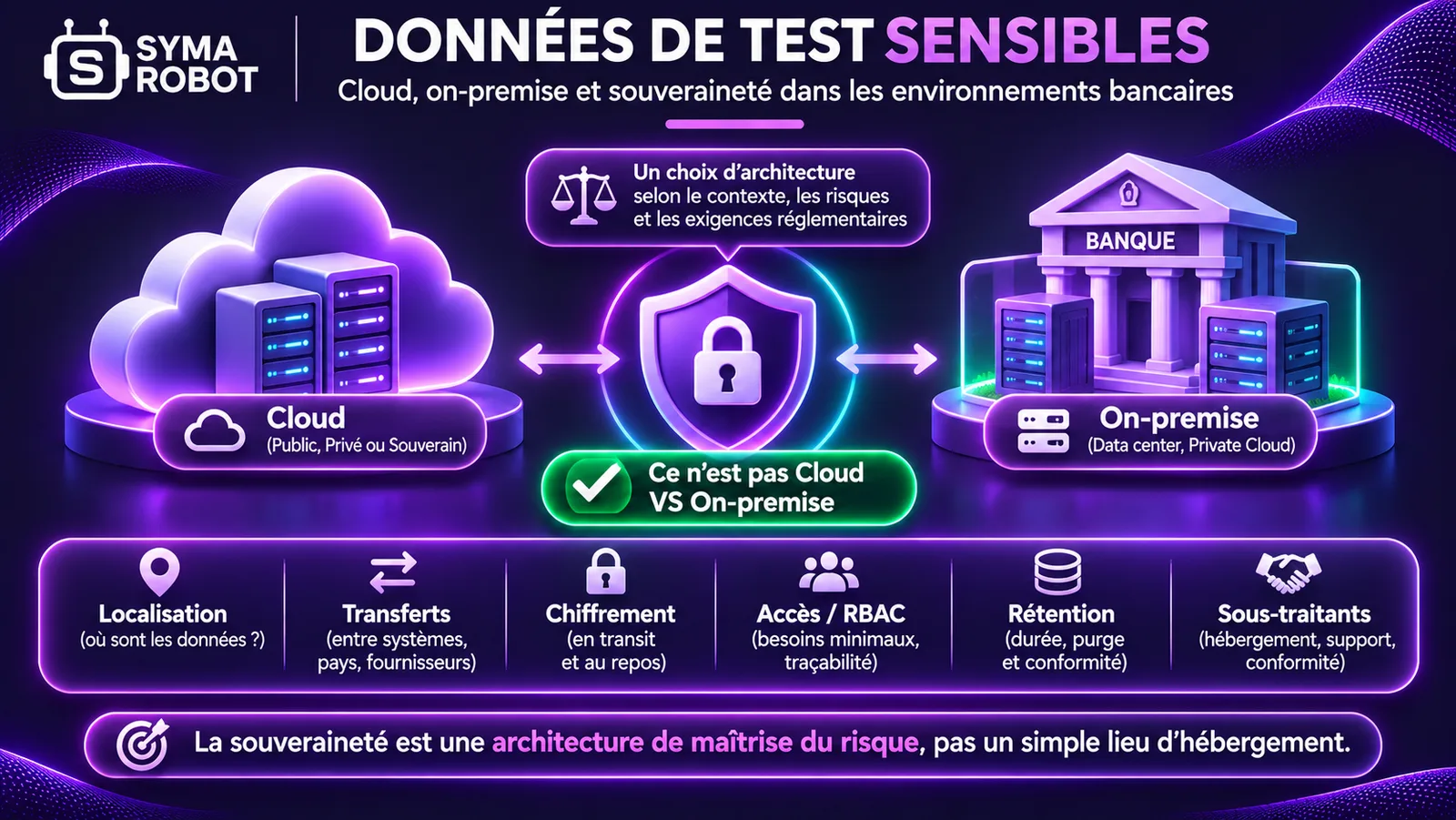
The answer cannot be reduced to “cloud or on-premise”. A server installed in the customer’s data center can be poorly secured. A properly architected cloud environment can enforce very strict controls. The right choice depends on the type of data, the risk, the transfers, contractual requirements and the regulatory framework.
Caution — This article presents technical and governance principles, not legal advice. Applicable requirements must be validated with your legal, compliance, DPO and CISO functions, and with the competent authorities.
1. Start by mapping the data actually handled
Before choosing where to host, you need to know what flows through the test. Does the script contain a phone number (MSISDN)? A customer ID? A password? A test card? Does the robot receive an OTP? Do screenshots show a balance or a name? Do the logs record headers or tokens?
This map must cover at least: input data, secrets, displayed data, generated data, screenshots and videos, logs, traces and results.
A piece of data can be absent from the central database and still appear in a video or a log file. Governance must therefore cover all the evidence the test produces.
2. Synthetic data first; real data only when needed
The first protection mechanism is minimization. If a scenario can be tested with synthetic or anonymized data or dedicated accounts, there is no technical reason to expose more data.
For payment environments, PCI DSS v4.0 states it clearly: live PANs are not used in pre-production environments, except where those environments are included in the Cardholder Data Environment and protected in accordance with all applicable requirements (requirement 6.5.5). Test data and test accounts must also be removed from system components before the system goes into production (requirement 6.5.6).
The principle generalizes: production data must not become test data out of convenience.
3. Data protection principles directly shape the test architecture
Most data protection laws share a common foundation. The GDPR, for example, requires that data be collected for specified, explicit and legitimate purposes, be adequate, relevant and limited to what is necessary, and not be kept longer than necessary (Article 5).
It also requires technical and organizational measures ensuring a level of security appropriate to the risk — including, as appropriate, pseudonymization and encryption (Article 32). When processing is entrusted to a processor, that processor must provide sufficient guarantees and the processing must be governed by a contract or other legal act (Article 28).
Depending on the country, the applicable national law may add its own requirements. For a testing platform, these principles directly affect the architecture: access to scripts, secrets, media, logs, backups, support accounts and subprocessors.
4. International transfers: the point that changes the cloud discussion
Chapter V of the GDPR governs transfers of personal data to third countries or international organizations. Article 44 sets the principle: such transfers must not undermine the level of protection guaranteed. They can rely on an adequacy decision by the Commission (Article 45) or, failing that, on appropriate safeguards such as the standard data protection clauses adopted by the Commission (Article 46).
Many national laws likewise make transfers abroad subject to conditions: a sufficient level of protection in the destination country, or even prior authorization from the supervisory authority.
Choosing an international SaaS should therefore not lead you to ask only “which region is my server in?”. You also need to map the flows to support services, backups, logs, subprocessors and any other processing. A transfer is not just a network path: it is processing subject to legal and organizational conditions.
5. Cloud, private cloud, on-premise: a matrix rather than a duel
| Question | Public cloud / SaaS | Private cloud | On-premise |
|---|---|---|---|
| Infrastructure control | Shared with the provider | High, depending on model | Very high on the customer side |
| Location | To be verified contractually | Configurable | Controlled by the customer |
| Operations | Provider + customer | Shared or internal | Mostly internal |
| Scalability | Generally strong | Strong, depending on capacity | Depends on the infrastructure |
| Transfers | To be mapped | To be mapped | Can be reduced, but not automatically zero |
| Security | Depends on configuration and provider | Depends on governance | Depends on internal governance |
This table is not a ranking. Each model shifts responsibilities, controls and risks.
6. Separate the control plane from the execution plane
For sensitive environments, an interesting architecture is to separate test orchestration from test execution.
The control plane manages scenarios, scheduling, permissions and statuses. The execution plane — web robot, physical mobile device or API runner — can stay inside the customer’s network or in a trusted zone close to the system under test.
This separation limits what has to leave the environment: for example, reporting a status and aggregated metrics while keeping certain secrets or sensitive media local, depending on the chosen policy.
7. Six controls to check before any deployment
- Location — Where are scripts, results, screenshots, videos, logs and backups stored?
- Flows and transfers — Which systems, countries, APIs, subprocessors and support teams can receive the data?
- Encryption and secrets — TLS in transit, encryption at rest where required, a secrets vault, rotation, and no plaintext secrets in scripts or logs.
- Access — RBAC, least privilege, MFA where relevant, tenant separation and logging of administrative access.
- Retention — Explicit durations per type of evidence, automated purging, backups included in the policy.
- Auditability — Who ran the test? Who viewed or exported a piece of evidence? Which configuration was active?
8. Videos, screenshots and logs: the often forgotten risk
Execution evidence is extremely useful for QA and root-cause analysis, but it can contain more information than the structured result itself.
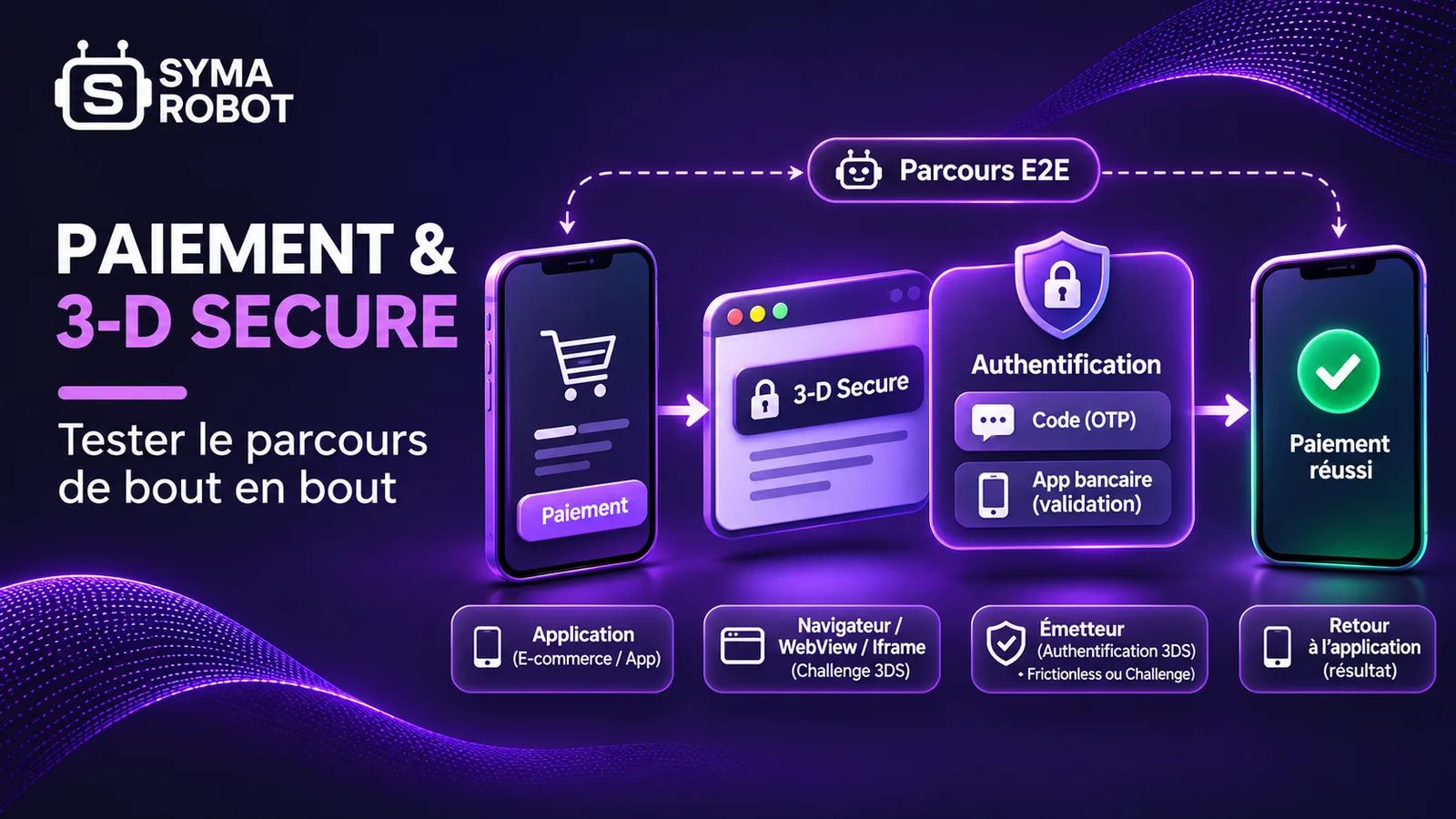
A screen can reveal a name, a phone number, a balance or an identifier. A log can contain a token. A video can record an OTP or a PIN if masking is not planned — a point that is all the more sensitive on a 3-D Secure payment journey.
Media must therefore be treated as potentially sensitive data: access control, masking where possible, protected URLs, short retention when the need allows, and traceability of who viewed what.
9. On-premise reduces some risks, but creates others
Installing the platform inside the customer’s IT system can reduce external transfers and meet certain architecture constraints. It also gives more control over the network, keys, backups and access.
But the customer also becomes responsible for more: patching, hardening, availability, backup, monitoring, certificate management and control of privileged accounts.
On-premise is therefore not synonymous with secure. Above all, it means more responsibilities are brought in-house.
10. The SYMA ROBOT approach
For SYMA ROBOT, this challenge points towards a flexible architecture: execution on web, API or mobile robots placed in the appropriate environment, and the ability to adapt the storage and flows of evidence to the customer’s level of sensitivity.
In highly constrained environments, the target principle is to bring execution closer to the system under test and to minimize the data that leaves the trusted zone.
The platform must also provide multi-tenant isolation, fine-grained access control, media protection, a retention policy and enough traceability for the customer to know exactly where their test data goes. For other aspects of test security, see also “Sécurité des Tests No-Code : Protéger Vos Données et Applications” (in French).
Key takeaway — Sovereignty is not just “where is the server?”. It is the ability to know what data exists, where it goes, under which jurisdiction, who can access it, with which keys, for how long and how it is deleted.
Architecture checklist
- Inventory the categories of data used by the tests.
- Identify personal data, secrets and payment data.
- Avoid real data when synthetic data is enough.
- Map storage, flows, countries, backups and subprocessors.
- Define RBAC, privileged accounts and traceability.
- Keep secrets out of scripts and logs.
- Define the policy for screenshots, videos and logs.
- Set retention periods and a verifiable purge.
- Choose where to execute based on risk and measurement needs.
- Validate transfers and processing with compliance, DPO and CISO functions.
Conclusion
For banking and fintech testing, the best architecture is not universal. The cloud can bring elasticity and industrialization; private cloud or on-premise can strengthen control over certain flows. The right choice starts with the data, its risk and its lifecycle. A testing platform designed for sensitive environments must therefore adapt to that governance rather than impose a single model.
Do your test journeys handle sensitive data or need to stay inside your IT system? Request a SYMA ROBOT demo: an architecture as close as possible to your environments and devices, with a tailored strategy for access, media and data flows.
Sources
Texts consulted on November 1, 2026. These references support general principles and do not constitute legal advice.
- GDPR (Regulation (EU) 2016/679) — official text on EUR-Lex; Articles 5, 28, 32, 44, 45 and 46 (consolidated version on gdpr-info.eu)
- PCI SSC — PCI DSS v4.0, SAQ D Service Provider, requirements 6.5.5 and 6.5.6