Blog 6 min read
Mobile testing: emulator, device cloud or real phone with a SIM?
- mobile-testing
- test-automation
- e2e-testing
- qos
- qoe
- monitoring
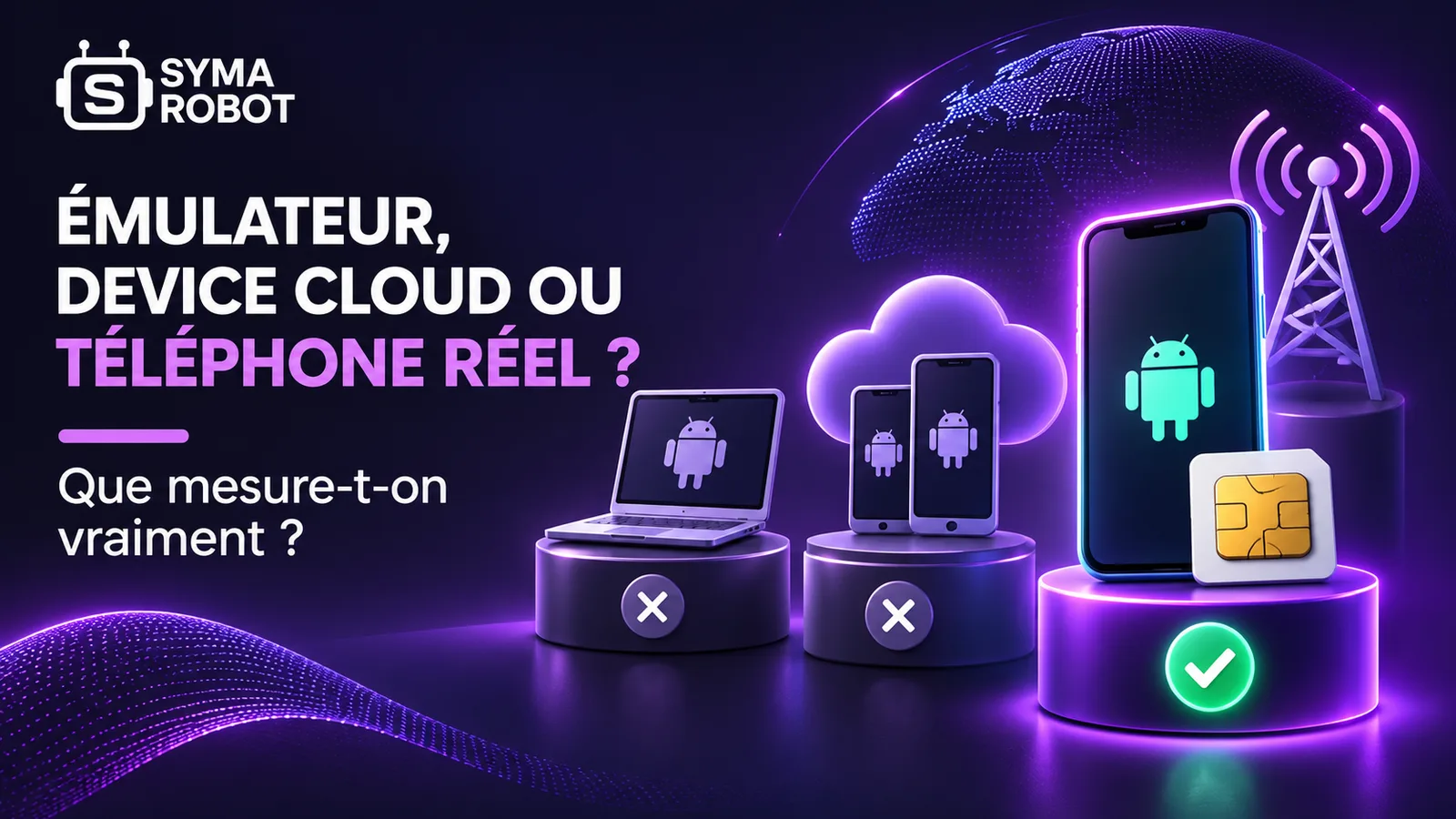
When a mobile journey needs to be automated, the first question is usually about tooling: Appium, a device cloud, an emulator or a physical phone? Yet the right question comes earlier: what are we actually trying to validate or measure?
An emulator, a physical smartphone hosted in a cloud and a smartphone deployed in the field with a real SIM can all run a scenario. But they do not observe exactly the same system. For a QA team, that distinction changes the nature of the evidence you get.
1. The emulator: fast, reproducible and ideal for testing early
An emulator reproduces a mobile environment in software. It is especially useful during development and in CI/CD pipelines: fast start-up, reproducible configurations, parallel execution and no hardware fleet to maintain.
It is a very good fit for functional tests that check navigation, a form, a display rule or an application regression. On its own, however, it does not measure the experience of a user on a physical handset connected to their carrier network.
In other words, the emulator answers “does this feature behave correctly in this simulated environment?” very well, but not necessarily “what is my customer experiencing, here and now, on their phone and their network?”.
2. The device cloud: real phones, accessed remotely
A common confusion is worth avoiding: “cloud device” does not necessarily mean “virtual phone”. Services such as AWS Device Farm, Firebase Test Lab or BrowserStack give access to real physical smartphones hosted in their data centers. Note that Firebase Test Lab is deprecated: Google has announced it will be fully shut down on September 30, 2027, and points users to its Developer Device Platform.
The benefit is considerable: you can quickly test many models, OS versions and screen sizes without owning the whole fleet. It is particularly effective for compatibility, multi-device regression testing and parallel execution.
But a physical phone does not automatically mean you are measuring the real mobile network of the targeted user. AWS Device Farm, for example, states that its devices have no carrier connection and cannot make phone calls or send SMS messages. BrowserStack offers SIM-enabled devices on its Team Pro and Enterprise Pro plans, in four countries so far (Australia, Ireland, India, the United States) and with a handful of carriers; its documentation specifies that these devices are meant for SMS testing, and that phone calls and mobile data are not supported in this mode.
The device cloud is therefore an excellent testing infrastructure. For QoS/QoE measurement tied to a carrier, you need to check precisely where the device is located, its SIM, its carrier, the network path and the capabilities that are actually available.
3. The real smartphone with a SIM: when the network is part of the system under test
For some journeys, the telecom network is not just a transport layer: it is part of the experience. Think of an OTP received by SMS, a USSD flow, a mobile money service, authentication tied to the phone number, or an app whose performance varies strongly with connectivity.
In that context, a physical smartphone located in the target country, fitted with the SIM of the carrier you want to observe and actually using that network, lets you measure a more complete chain: app, handset, SIM, network, third-party services, APIs and backend.
This architecture does not replace the device cloud. It answers a different question: “does the journey work under the real conditions the targeted user faces, and at what level of service?”
4. Three environments, three goals
| Criterion | Emulator | Physical device cloud | Field device + targeted SIM |
|---|---|---|---|
| Functional validation | Very well suited | Very well suited | Suited |
| Model/OS compatibility | Virtual only | Excellent | Targeted |
| Real hardware | No | Yes | Yes |
| Real SMS/OTP | Not native | Depends on plan and SIM | Yes |
| Targeted carrier network | No | Depends on plan and location | Yes, if set up that way |
| Field QoS/QoE measurement | No | Partial, depending on setup | Yes, for the deployed context |
| Scalability/parallelism | Excellent | Excellent | Needs sizing |
| Hardware maintenance | Low | Outsourced | To be managed |
Read this table as a decision grid, not a ranking: the best architecture depends on the risk you are trying to cover.
5. Example: a login with an SMS OTP
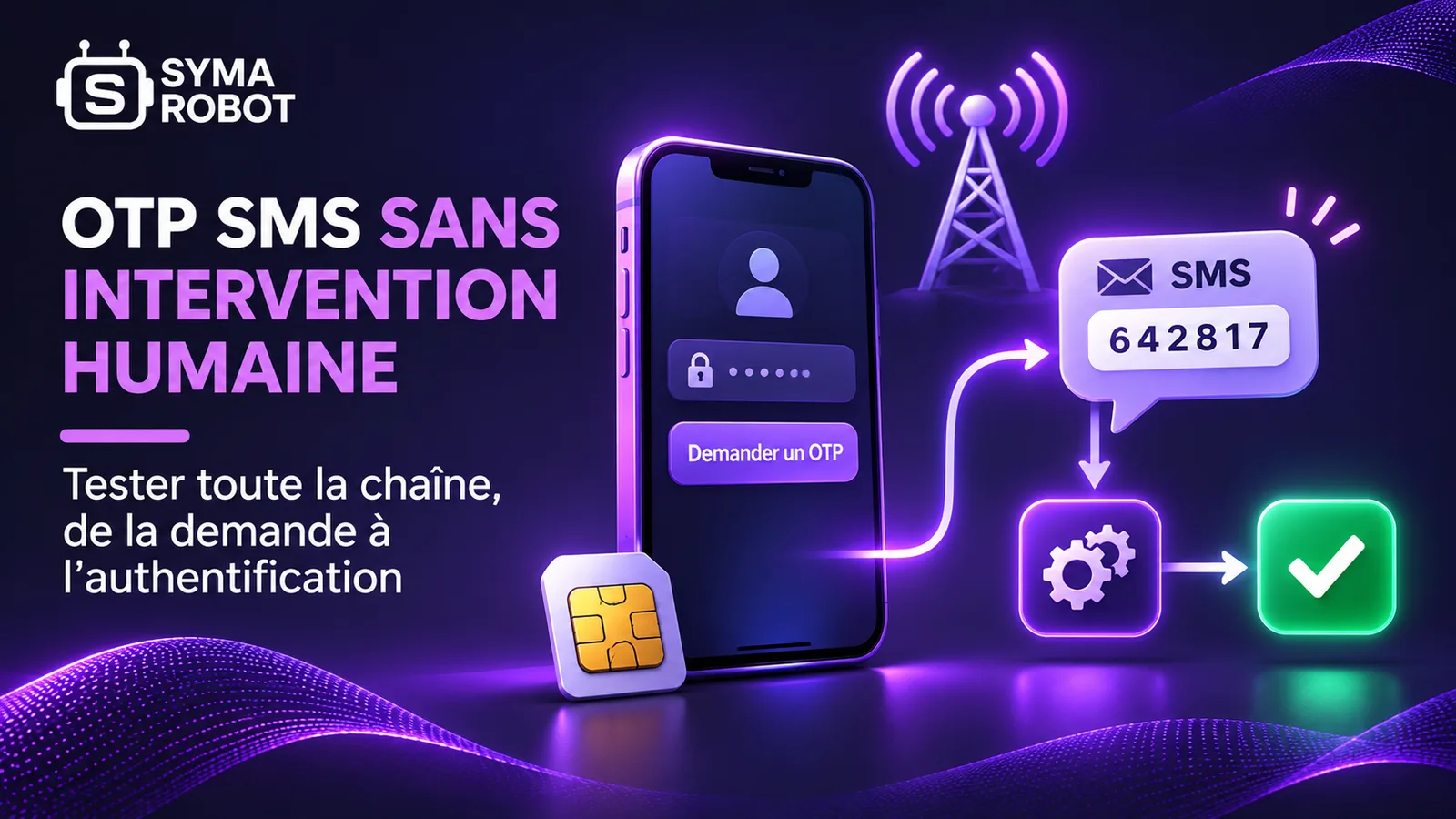
Take a login that triggers an OTP sent by SMS. An emulator can validate the interface and the application logic if the OTP is injected or simulated. A device cloud fitted with a compatible SIM can validate SMS reception within the limits of the service on offer. A phone on the targeted carrier network additionally lets you observe how the journey really behaves on that network.
You can then measure separately the application response time, the delay between the request and the SMS arrival, the total time to authentication and the journey success rate. These are service metrics, not just UI assertions.
6. Testing and monitoring are not the same thing
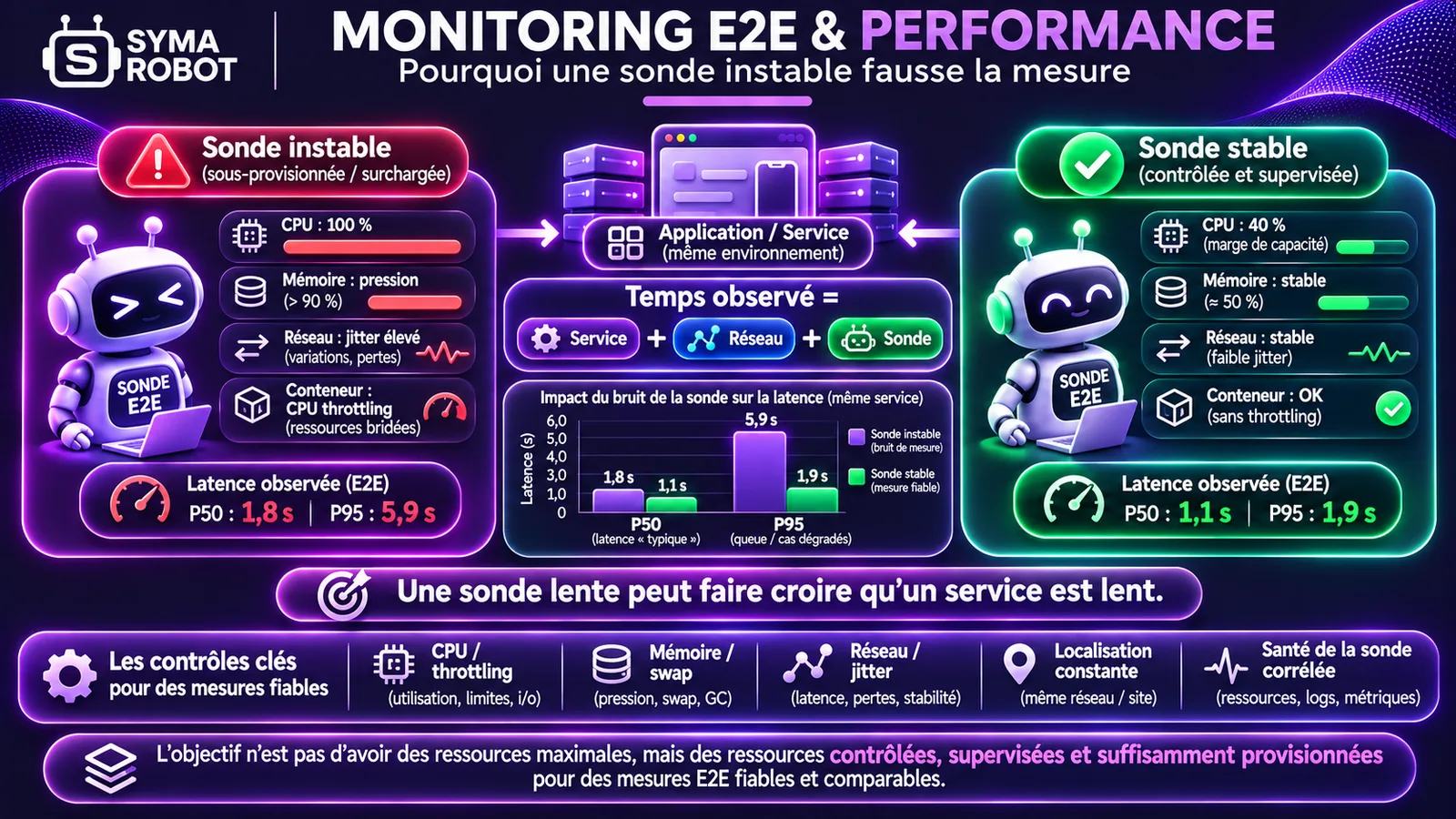
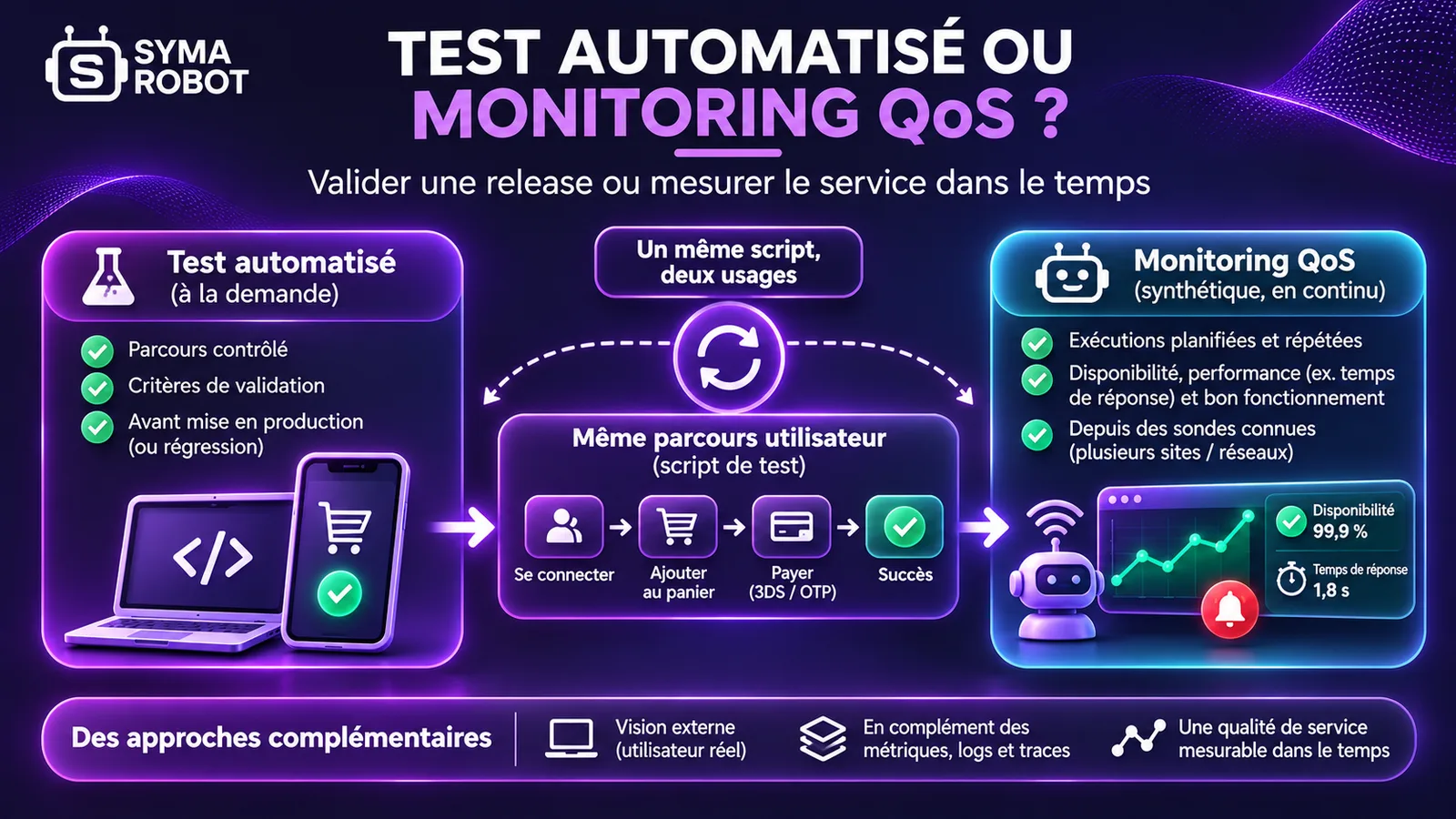
A test campaign usually aims to validate a release, a feature or a compatibility matrix. Synthetic monitoring repeats the same journey over time to detect degradation, measure availability and track performance.
A device cloud is especially powerful for growing coverage quickly. A field robot, for its part, can become a permanent probe of the user experience. The two approaches are complementary: broad coverage on one side, targeted operational representativeness on the other.
7. The SYMA ROBOT approach
SYMA ROBOT automates Web, Mobile and API journeys and can run scenarios on robots deployed as close as possible to the environment being observed. On mobile, the goal is to be able to use a physical smartphone and, when the use case requires it, a real SIM, so that the components that actually shape the experience stay inside the measurement scope.
This approach makes the most sense for carriers, banks and fintechs when journeys combine an app, SMS/OTP, telecom services, payment or third-party systems. The point is then no longer just whether a button works, but having usable end-to-end evidence.
Key takeaway — Emulator, device cloud and field phone are not three quality levels. They are three different instruments. The right choice aligns the execution environment with the question the test actually needs to settle.
Conclusion
To speed up development, the emulator remains essential. To cover a wide variety of physical handsets quickly, the device cloud is extremely effective. And when a journey depends on the SIM, the network or local conditions, a real smartphone connected to the targeted network adds a measurement dimension that other environments do not always reproduce. The most robust strategy is often to combine all three rather than pick just one.
Want to measure a mobile journey from a physical handset under real conditions? Request a SYMA ROBOT demo.
Sources
Documentation consulted on November 1, 2026. These references support the technical distinctions above; they are not endorsements.
- AWS Device Farm — Device support in AWS Device Farm and the developer guide
- Firebase Test Lab — overview (deprecated, shutdown announced for September 30, 2027)
- BrowserStack — Test apps on SIM enabled real devices, Real device features and the App Live overview