Blog 6 min read
Automating SMS OTP testing without human intervention
- mobile-testing
- test-automation
- e2e-testing
- monitoring
- security
- qos
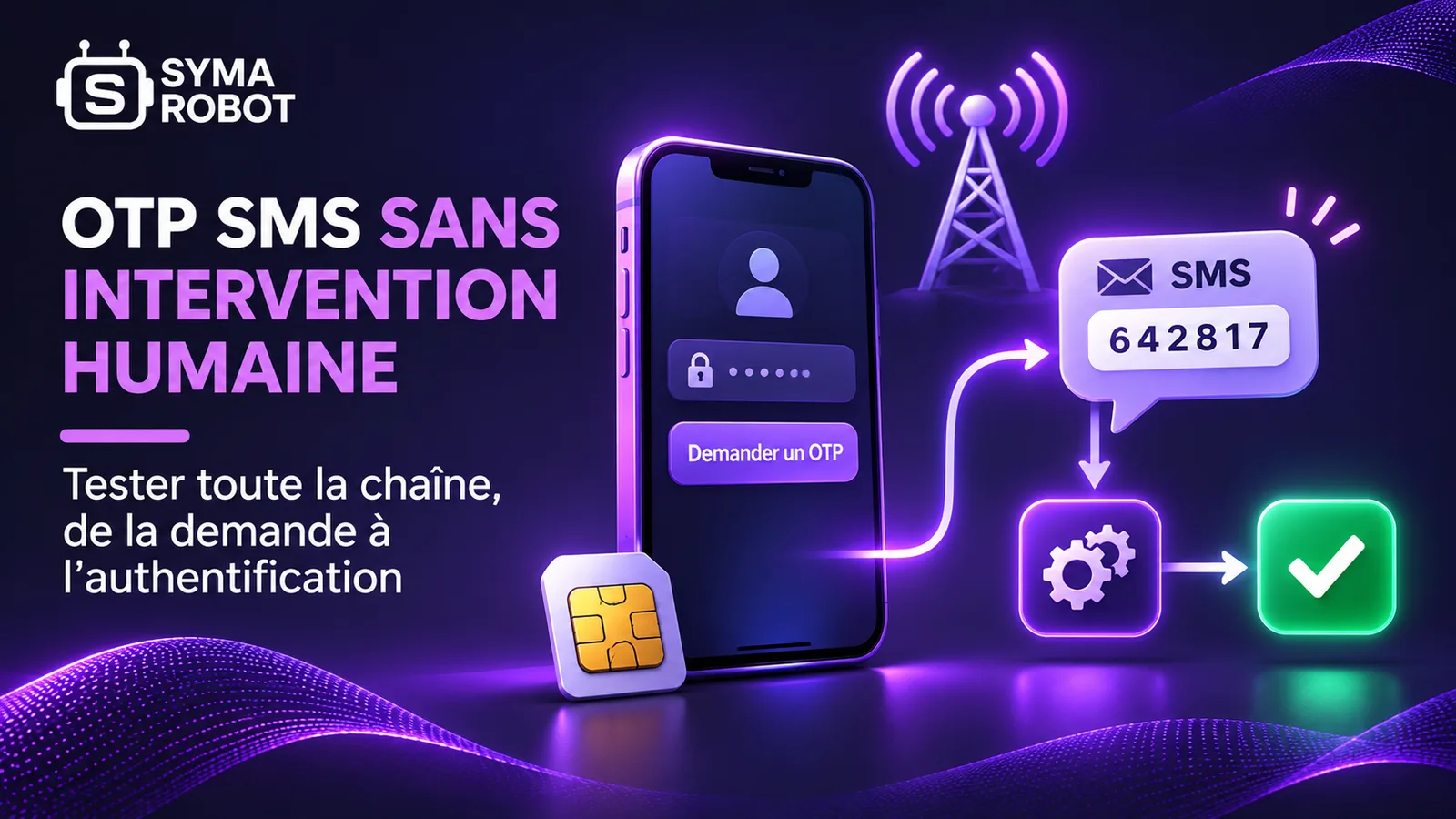
A mobile scenario can be automated end to end… right up to the moment the app asks for a code received by SMS. The robot waits, a tester reads their phone, copies the six digits and restarts the scenario. At that point the automation is no longer truly autonomous, and the performance measurement is distorted.
For a bank, a fintech, a carrier or a mobile money app, the OTP is not a technical detail. It is part of the authentication experience. If it arrives late, never arrives, expires or is rejected, the user journey fails.
1. Why OTPs so often break E2E automation
A classic test knows how to tap “Send code”, wait for a field and type a value. The problem is dynamically obtaining the code that was just sent to the number actually used by the test.
A first strategy is to bypass the OTP in the test environment, use a fixed code or query a test backend directly. It is an efficient way to validate application logic quickly, but it takes the SMS chain out of the tested scope.
A second strategy is to pause the scenario and ask a human to provide the code. The journey becomes testable, but it is no longer autonomous, it is hard to monitor 24/7, and its response times no longer reflect those of the service.
2. The E2E approach: let the SMS travel the real chain
To measure the journey as a user experiences it, the test can keep the SIM and the SMS channel in the loop:
OTP request → authentication platform → SMS infrastructure / carriers → mobile network
→ SIM → handset → code extraction → input → validation → successful authentication
The robot triggers the request from the app, waits for the message on the test handset, retrieves the code matching the right message and the right scenario, enters it, then checks the final business outcome. This is where a physical smartphone with a real SIM makes the difference, as we explained in “Mobile testing: emulator, device cloud or real phone with a SIM?”.
This approach requires safeguards: time correlation, filtering by sender or expected content, code expiry, masking the secret in logs and deleting sensitive data after use.
3. What to measure
| Metric | Start / end | What it tells you |
|---|---|---|
| OTP trigger time | User action → request confirmed | Application responsiveness |
| Observed delivery delay | Timestamped request → SMS seen on the handset | Delivery experience seen at the device |
| Automatic input time | SMS seen → OTP injected | Robot performance |
| Validation time | OTP submitted → authenticated screen or state | Verification service responsiveness |
| E2E time | OTP request → successful authentication | Overall experience |
| Success rate | Completed journeys / executed journeys | Functional availability |
Mind the causality — If the SMS reaches the phone late, the robot can prove the delay observed on the user side. It cannot conclude on its own that the SMSC, the network or the OTP provider is the cause. A reliable root-cause analysis requires correlating that observation with the statuses and metrics of the components involved.
4. “Delivered” does not always mean “journey succeeded”
Verification platforms usually distinguish the state of the message from the state of the verification. A message can be accepted, sent or reported as delivered while the user has not yet completed authentication.
Twilio Verify, for example, publishes two separate event streams: the message status (SENT, DELIVERED, UNDELIVERED, FAILED) and the verification status (PENDING, APPROVED, CANCELED, EXPIRED, MAX_ATTEMPTS_REACHED). A verification only moves to APPROVED after the entered code has been checked. That separation illustrates an important principle: technical delivery and business success are two different pieces of evidence.
An E2E robot must therefore go all the way to the expected outcome: session opened, transaction confirmed, number verified or another observable business state.
5. App autofill and test robots: two different topics
Android provides the SMS Retriever API, which lets a properly integrated app automatically retrieve the message containing the OTP without requesting any extra permission. On iOS, the system detects codes received by SMS and suggests them to the user for autofill.
These mechanisms improve the product experience, but they do not replace a testing strategy. The test still has to verify that the message was triggered, received within the expected delay, used correctly and accepted by the backend.
6. OTP-specific false positives
The main risk is declaring the test successful because an OTP field was filled in. That proves neither that the right SMS was used, nor that the code was fresh, nor that authentication was accepted.
A robust test must check the identity of the expected message, enforce a time window, prevent an old code from being reused, confirm the final business state and keep usable timestamps for analysis.
7. Security: automate without exposing the secret
An OTP is an ephemeral secret. Automation must not turn a security mechanism into a data leak. The code should be masked in logs and screenshots when it is not needed as evidence, kept for as short a time as possible and handled only within the authorized execution environment.
In a banking or carrier environment, access to handsets, SIMs and traces must also be controlled and auditable.
8. The SYMA ROBOT approach
In a mobile scenario running on a physical smartphone, SYMA ROBOT can bring SMS reception into the automated journey so that no human has to step in between requesting the code and entering it.
The benefit goes beyond saving time: the execution becomes repeatable and usable for monitoring. By timestamping each step, the robot can measure the observed delay between the OTP request and its arrival on the handset, then the total time to authentication.
That evidence can then be compared with application, API and backend logs, or with the statuses provided by the SMS service when that data is available. It is this correlation that gradually takes you from “the journey is slow” to “here is where the degradation most likely sits”.
Conclusion
Automating an OTP is not just about finding six digits. For a reliable E2E test, you need to preserve the chain actually in use, retrieve the right code without human intervention, measure each step and verify the final business outcome. That is what turns a test script into a true quality-of-service probe.
Is one of your mobile journeys blocked by an SMS OTP? Request a SYMA ROBOT demo: a scenario run on a physical smartphone with a test SIM, from the code request all the way to business validation.
Sources
Documentation consulted on November 1, 2026. These references support the general technical principles above; they are not endorsements.