Blog 6 min read
Testing a 3-D Secure mobile payment end to end
- mobile-testing
- test-automation
- e2e-testing
- security
- monitoring
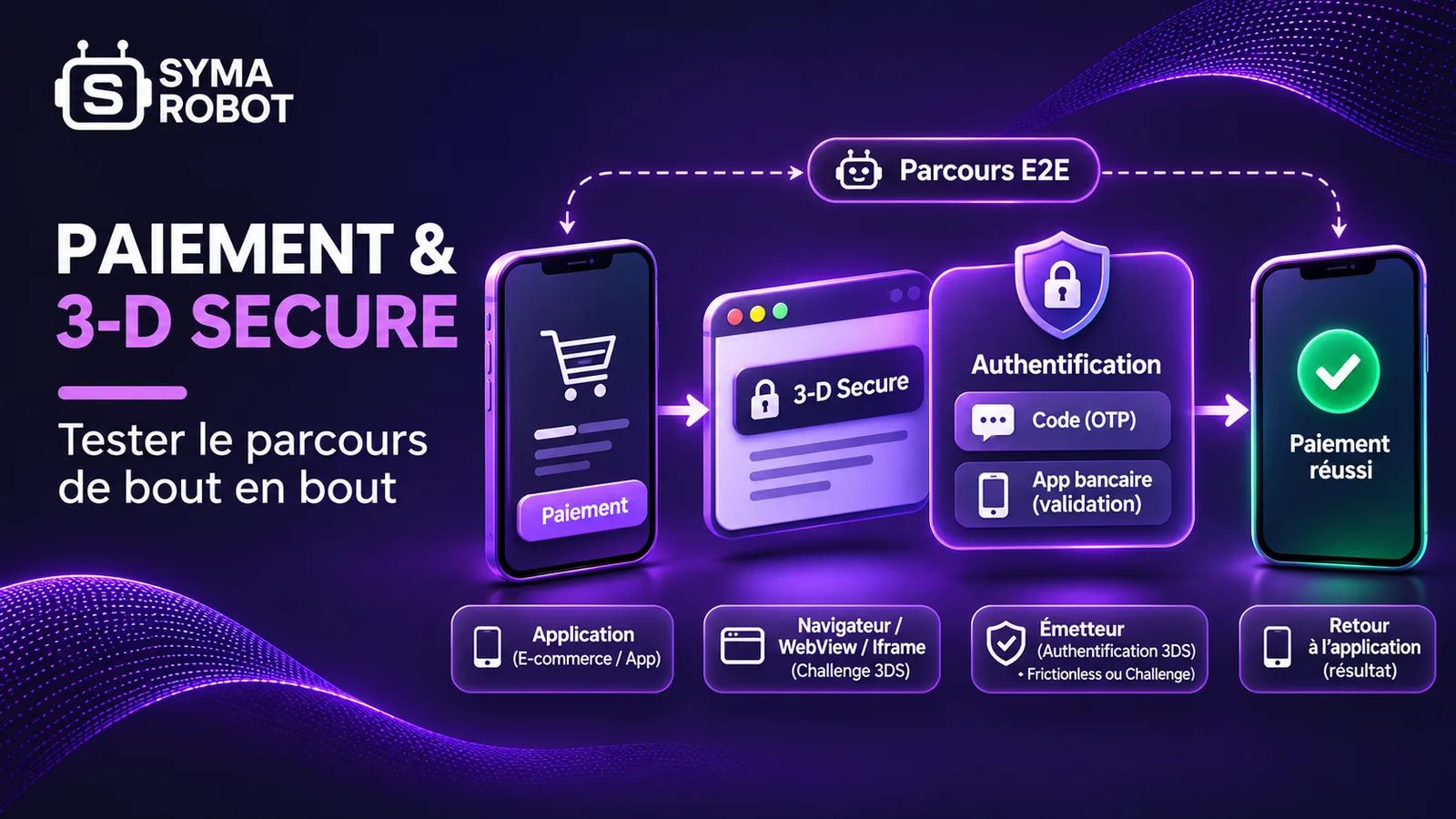
A payment scenario looks simple: pick a product, enter or select a payment method, confirm, then check that it succeeded. In E2E automation, however, it is often one of the hardest journeys to stabilize.
The reason is structural: the robot does not necessarily stay in the same app, the same DOM, the same domain or even the same authentication channel. The journey may cross the merchant app, a WebView or a browser, the payment provider, the issuer’s domain, a 3-D Secure challenge, an OTP or a banking app, and then return to the merchant.
1. First, understand what EMV 3-D Secure actually does
EMV 3-D Secure is a fraud prevention protocol for card-not-present e-commerce payments. It enables data to be exchanged between the merchant and the issuer, so that the issuer can assess the transaction risk and authenticate the cardholder.
Two broad behaviors must be distinguished. In a frictionless flow, the transaction is authenticated without any extra cardholder interaction: for many purchases, the cardholder clicks “Buy” and the payment is approved. In a challenge flow, the issuer’s authentication server (the ACS) requests an additional authentication step.
That step is not necessarily an OTP. EMVCo lists, among others, one-time passcodes, validation in the banking app (out-of-band authentication), decoupled authentication, biometrics and knowledge-based questions. A test scenario that always expects “the OTP screen” is therefore fragile by design.
2. Why iframes cause trouble on the Web
In a browser 3DS flow, EMVCo describes the challenge being opened in an iframe; in an app-based flow, the data is handed to the 3DS SDK embedded in the app. For WebDriver, the elements inside an iframe are not part of the main document until the driver explicitly switches into the frame.
Selenium documents this behavior: you identify the frame, call switchTo().frame(...), interact with its content, then return to the main document with defaultContent(). In practice, a frame that loads late, is nested or gets replaced dynamically is enough to break a script that assumes a single DOM.
So the right test should not just look for a more tolerant XPath. It must model the context change.
3. On mobile: Native → WebView → browser → banking app → back
The problem gets even more interesting in a hybrid mobile app. Part of the checkout may be native, then the payment opens in a WebView. Authentication can then trigger a redirect or a hand-off to a browser, or even to the banking app for out-of-band validation.
The robot must know which context it is in before looking for an element. With Appium, for example, the native context and each active WebView are distinct contexts that the test switches between explicitly. A robust strategy therefore separates context detection from business logic: native context, WebView context, new window or tab, external app, then back to the original app.
Deep links, Android intents, universal links and return delays must also be treated as transitions of the journey, not as anomalies of the test framework.
4. The real journey to test
Checkout → payment initialization → 3DS authentication → optional challenge → back to merchant → business confirmationAt every step, the question should be: what evidence lets us state that the step is really complete?
| Step | Possible evidence | Useful metric |
|---|---|---|
| Initialization | Payment page or state created | Time to open the payment |
| 3DS | Challenge displayed or frictionless observed | Time to 3DS decision |
| Authentication | Challenge completed, response received | Challenge duration |
| Back to merchant | The app or page regains control | Redirect and return time |
| Business outcome | Payment confirmed or expected status | E2E time and success rate |
5. The five classic mistakes in a payment test
- Always expecting an OTP. The flow may be frictionless or use another challenge. The test must accept the allowed branches and verify their outcome.
- Treating the iframe as the main DOM. On the Web, the driver must explicitly switch into the frame context, then leave it.
- Confusing authentication with a successful payment. A successful 3DS challenge does not prove that the transaction was authorized and correctly recorded by the merchant.
- Only checking a “success” screen. A screen can be displayed while the backend holds another status. For critical tests, the UI state should ideally be matched against available API or backend evidence.
- Using fixed waits. Redirects, the ACS, OTPs and third-party systems have variable timings. Waits should target observable events or states rather than arbitrary pauses.
6. Test the branches, not just one happy path
A mature 3DS strategy should cover at least the behaviors the test environment can trigger: frictionless, successful challenge, rejected or failed challenge, timeout or abandonment, incorrect return to the app and technical error.
The goal is not to artificially force every real bank to produce every case. It is to have an environment and test data that let you check how the app reacts to the relevant states. And never to bypass security mechanisms in production: use authorized test payment methods and environments.
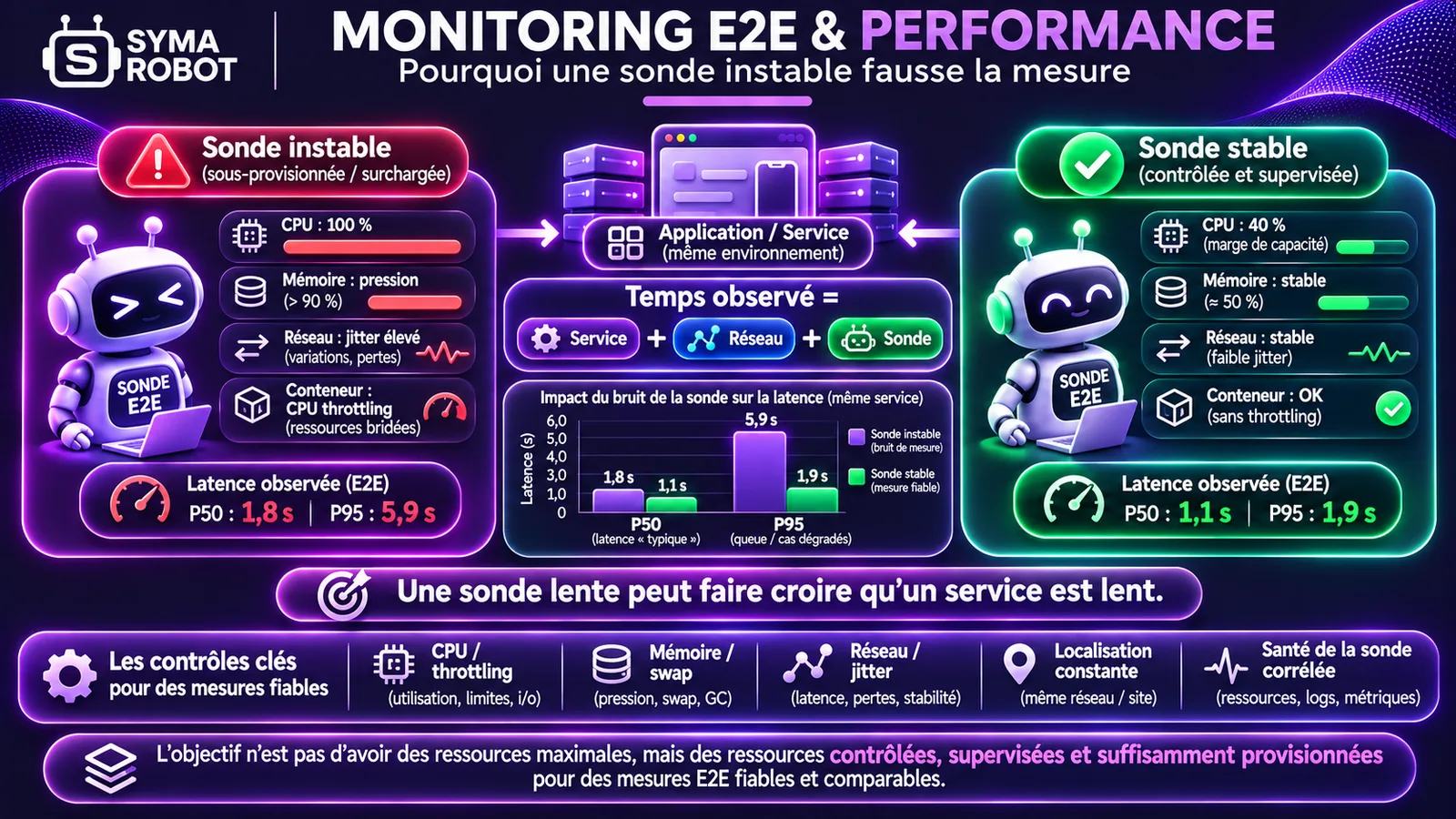
7. Measure the payment as an E2E experience
For monitoring, the success rate alone is not enough. Total time can degrade while every component remains technically available.
Timestamps placed at each transition let you separate payment initialization time, the wait before the challenge, authentication duration, the time to return to the app and the final confirmation. These observations do not automatically identify the cause, but they point to the segment of the journey where to look.
By then correlating them with metrics from the payment provider, the backend, the APIs or application observability, you move closer to a fact-based root-cause analysis.
8. The SYMA ROBOT approach
SYMA ROBOT aims to model payment as a multi-context journey rather than a simple sequence of selectors. The robot can run the steps on Web or Mobile, capture execution evidence and timestamp the key transitions.
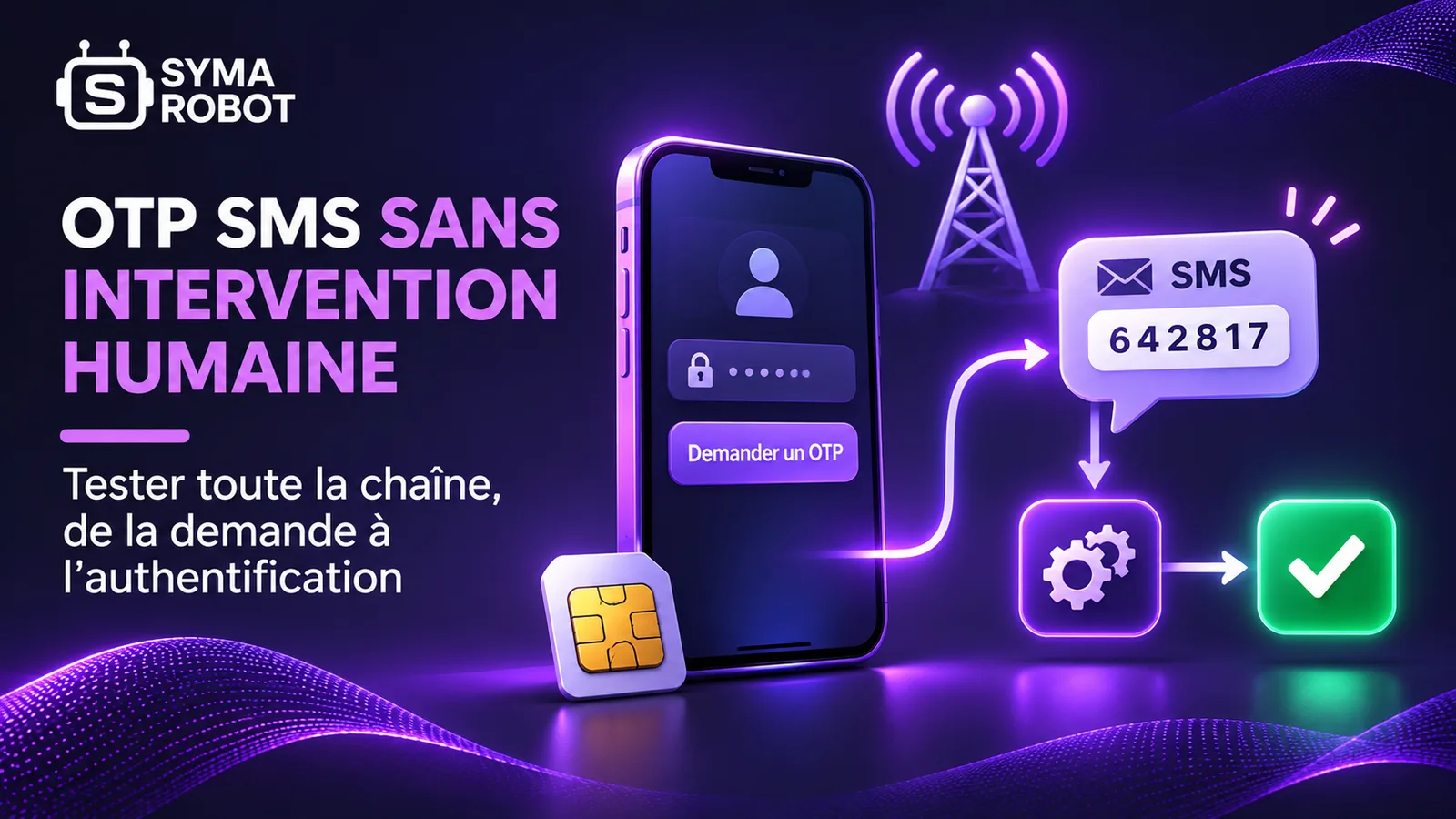
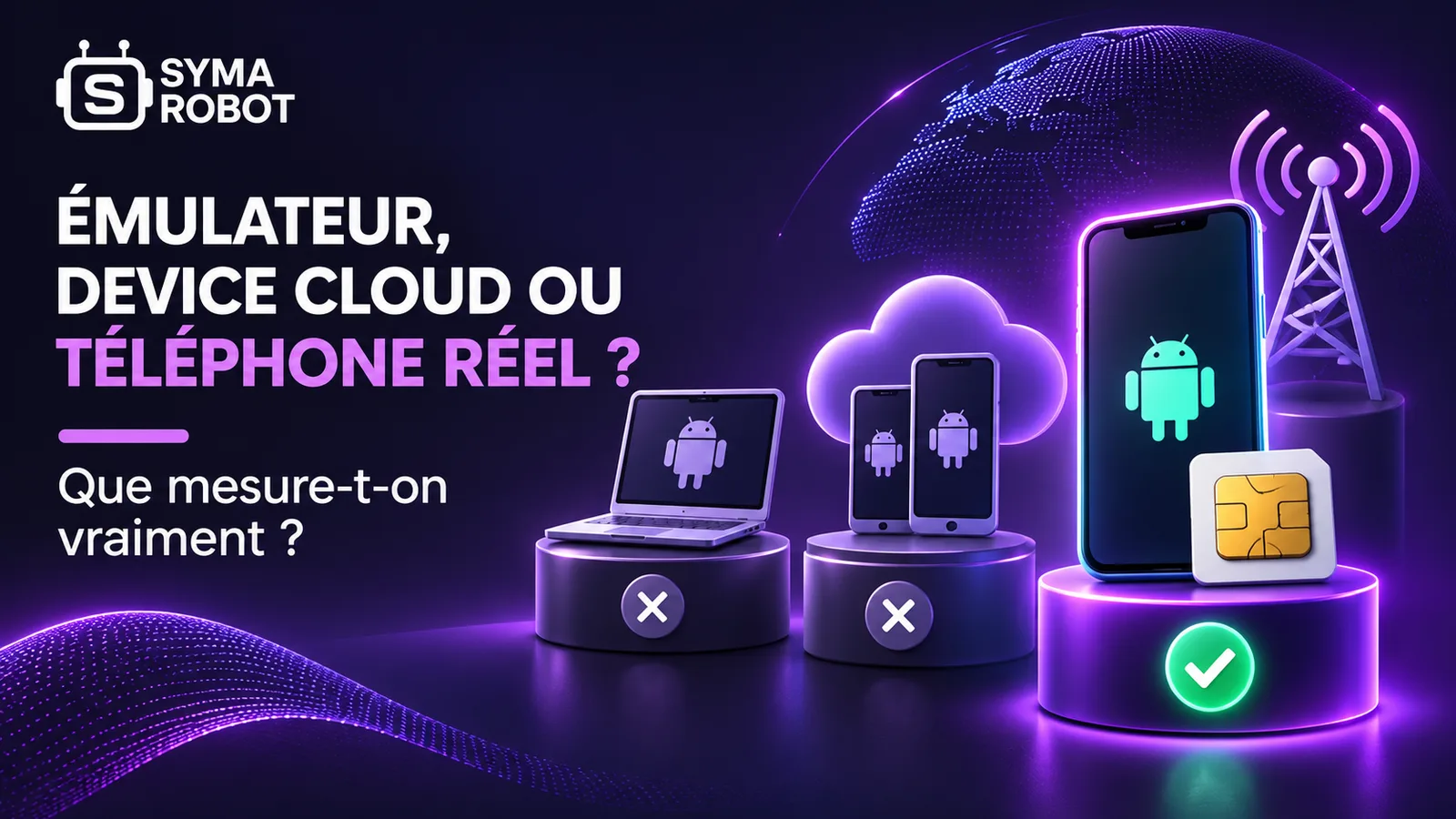
For an authorized scenario that includes an OTP, the logic described in our article “Automating SMS OTP testing without human intervention” can also be integrated to remove human intervention. When the journey switches to a Web context or an external app, the automation strategy must handle that change explicitly — which is where a physical smartphone with the banking app installed really makes sense.
The goal is simple: do not declare “payment OK” because the robot clicked the last button, but because the expected business outcome was observed and documented.
Key takeaway — 3-D Secure is not “an OTP popup”. It is an authentication step that can be frictionless or challenge-based, and that can cross several contexts. A robust test models those transitions and verifies the final business outcome.
Conclusion
Payment journeys break overly linear automation because they are distributed by nature. Iframes, WebViews, redirects, the ACS, OTPs, banking apps and the return to the merchant are all technical boundaries. The answer is not to pile up XPaths and timeouts, but to treat payment as an E2E state machine, with evidence at every transition.
Want to automate a real payment journey, including its context changes and authentication? Request a SYMA ROBOT demo on an authorized test scenario.
Sources
Documentation consulted on November 1, 2026. Official documentation is preferred; these references are not endorsements.
- EMVCo — EMV 3-D Secure
- EMVCo — EMV 3DS whitepaper: Challenge Flow, Business Overview, Technical Features, Decoupled Authentication and Challenge Autofill
- Selenium — Working with IFrames and frames
- Appium — Managing Contexts